


Finding the right supplement can feel overwhelming, especially when training demands peak performance and reliable recovery. The market is crowded with bold claims and confusing labels, leaving athletes across the United Kingdom and Ireland searching for real answers. Trusted supplement reviews blend scientific evidence and genuine user experiences, helping you make informed choices that protect your health and maximise your results. This guide shows how quality reviews cut through marketing noise, ensuring you invest in products that deliver—not just promise.
Table of Contents
- What Are Supplement Reviews And Why They Matter
- Types Of Reviews For Sports Supplements
- How Reviews Influence Buying Decisions
- Spotting Reliable Versus Misleading Reviews
- Maximising Results: Using Reviews Responsibly
Key Takeaways
| Point | Details |
|---|---|
| Importance of Supplement Reviews | They help identify effective and safe products, which is crucial for athletes seeking to enhance performance. |
| Types of Reviews Matter | Understanding the differences between single-ingredient and combination reviews aids in making informed decisions. |
| Evaluating Credibility | Look for verified purchase badges and consistent feedback to distinguish genuine reviews from misleading ones. |
| Cross-Referencing Sources | Check multiple platforms and reviewer backgrounds to ensure comprehensive and reliable information before purchasing. |
What Are Supplement Reviews and Why They Matter
Supplement reviews are detailed assessments of dietary supplements that cover effectiveness, safety, quality, and regulatory compliance. They combine scientific research with real user experiences to give you the full picture before you buy.
For competitive athletes and fitness enthusiasts, this matters more than most. Supplements can significantly impact your performance, recovery, and body composition. You need confidence that what you’re taking actually works and won’t compromise your health or undermine months of training.
Why Reviews Matter for Your Training
Supplements vary dramatically in quality and actual effectiveness. Some products deliver exactly what they promise. Others fall short or contain ingredients that don’t match the label. Reliable reviews help you identify safe and effective products rather than wasting money on ineffective alternatives.
You face specific challenges most supplement buyers don’t:
- Performance variability – A subpar protein powder or amino acid supplement directly impacts recovery between sessions
- Safety concerns – Contaminants or unlisted ingredients can disqualify you from competition or damage long-term health
- Regulatory gaps – Dietary supplements face less rigorous oversight than pharmaceutical drugs, making independent reviews crucial
- Marketing noise – Brands make bold claims; reviews separate fact from hype
Think of reviews as your due diligence before investing in a supplement regimen. They answer the questions you’d ask if you could speak directly with previous users and independent scientists.
What Makes Reviews Valuable
Not all reviews are created equal. The best ones address what actually matters to your goals:
- Scientific backing – Does research support the claimed benefits?
- User results – What did real athletes experience with training and recovery?
- Quality and purity – Does the product contain what’s on the label?
- Safety profile – Are there side effects or medication interactions you should know?
- Value for money – Does the price reflect the product’s actual performance?
Quality reviews eliminate guesswork and help you invest in supplements that genuinely support your performance goals, not just your supplement cabinet.
Reviews also flag critical details that marketing ignores. Things like whether a protein powder mixes cleanly, if joint support takes 4 weeks to show results, or whether a fat burner causes energy crashes. These practical insights come from users who’ve actually used the product during training.
The Trust Factor
When reviews come from verified purchases or independent testing labs, they carry real weight. You’re seeing what happened in real training scenarios, not laboratory conditions. This is especially valuable when evaluating recovery supplements or performance enhancers where individual response varies.
Pro tip: Read reviews from athletes with similar training goals and body types to yours—their results will be far more predictive of your own outcome than generic feedback.
Types of Reviews for Sports Supplements
Not all supplement reviews are the same. Different types evaluate different aspects, and understanding which review type matters most will help you make better purchasing decisions for your training goals.
Sports supplement reviews fall into distinct categories based on what they assess and who conducts them. Some focus purely on scientific evidence, whilst others emphasise real-world user experiences during actual training. The best purchasing decisions come from reading multiple review types.
Single-Ingredient vs. Combination Reviews
Reviews differ significantly based on supplement complexity. Single-ingredient supplements like creatine and caffeine are straightforward to evaluate—researchers have decades of studies on these compounds, making it easier to assess effectiveness and safety.
Combination supplements are messier. They contain multiple active ingredients, making it harder to identify which component actually delivers results. Reviews for these products must address:
- Individual ingredient efficacy
- How ingredients interact with each other
- Whether the dosages match research recommendations
- Potential synergistic effects or contradictions
When reviewing combination products, seek reviews that break down each ingredient separately rather than treating the formula as a black box.
Here’s how single-ingredient and combination supplement reviews differ in focus and usefulness:
| Review Type | Evaluation Focus | Strengths | Limitations |
|---|---|---|---|
| Single-Ingredient | One nutrient, proven effects | Easier to assess efficacy and safety | Less tailored to complex needs |
| Combination Supplement | Multiple ingredients, interactions | Can support broader goals | Harder to pinpoint true effect |
Scientific Evidence vs. User Experience Reviews
Clinical research reviews examine peer-reviewed studies. They tell you what scientists have proven in laboratory conditions—how much creatine improves strength, or whether vitamin D enhances endurance.
User experience reviews document what actually happens during training. An athlete might report that a recovery supplement helped them hit personal bests or reduced soreness between sessions. This real-world feedback matters because your body isn’t a laboratory.
The most credible reviews combine both—research-backed ingredients with verified user results from athletes with similar goals to yours.
Neither type alone tells the complete story. Research proves efficacy; user reviews prove practicality.
Specialist Performance Reviews
Some reviews focus specifically on performance enhancers (strength, power, speed), recovery aids (muscle repair, endurance), or general wellness (joint support, immune function). Specialist reviews understand the nuances of how supplements work within different training contexts.
A review evaluating fat burners for endurance athletes differs from one assessing them for strength competitors. Context matters enormously.
Pro tip: When reading reviews, prioritise those from sources that specify athlete type (endurance, strength, mixed sport) over generic reviews, since supplement effectiveness varies dramatically by training discipline.
How Reviews Influence Buying Decisions
Reviews shape your purchasing choices more than you probably realise. When you scroll through supplement options online, reviews act as social proof—they tell you whether other athletes actually got results or wasted money.
The influence is powerful. Positive reviews increase consumer confidence in product quality21/final/en/pdf), whilst negative reviews can immediately eliminate a supplement from consideration. For competitive athletes, this matters because your supplement budget is limited and mistakes are costly.
The Psychology Behind Review Influence
Your brain uses reviews as shortcuts. Rather than reading every ingredient study yourself, you rely on aggregated feedback from hundreds of users. This is rational, but it also creates vulnerabilities.
Reviews influence you through several mechanisms:
- Social proof – If 87% of reviewers report improved recovery, you’re more likely to trust the product
- Credibility signals – Reviews from verified purchases carry more weight than anonymous feedback
- Detailed descriptions – Specific results (“gained 3kg of muscle”) convince more than vague praise (“great product”)
- Reviewer similarity – A review from someone with your body type and goals feels more relevant
You’re essentially borrowing others’ experiences to reduce your own risk.
What Makes Reviews Actually Persuasive
Review characteristics like credibility, positivity, and trustworthiness strongly shape purchase intention. But not all five-star reviews are created equal.
The most persuasive reviews include:
- Specific outcomes – Quantifiable changes (strength gains, recovery time, soreness reduction)
- Honest trade-offs – Mention both benefits and drawbacks
- Verified purchase badge – Proof the reviewer actually bought and used the product
- Context about the reviewer – Their training style, goals, and body type
- Timestamp relevance – Recent reviews reflect current product batches and quality
Beware of suspiciously perfect reviews with generic praise and no specifics—these often indicate manipulation rather than genuine user experience.
Fake or heavily manipulated reviews distort your decision-making by inflating expectations or hiding legitimate concerns.
The Volume Effect
More reviews generally mean better information, but not always. A supplement with 200 detailed reviews gives you stronger confidence than one with only 15. However, 200 five-star reviews with identical wording raise red flags—that’s likely manipulation.
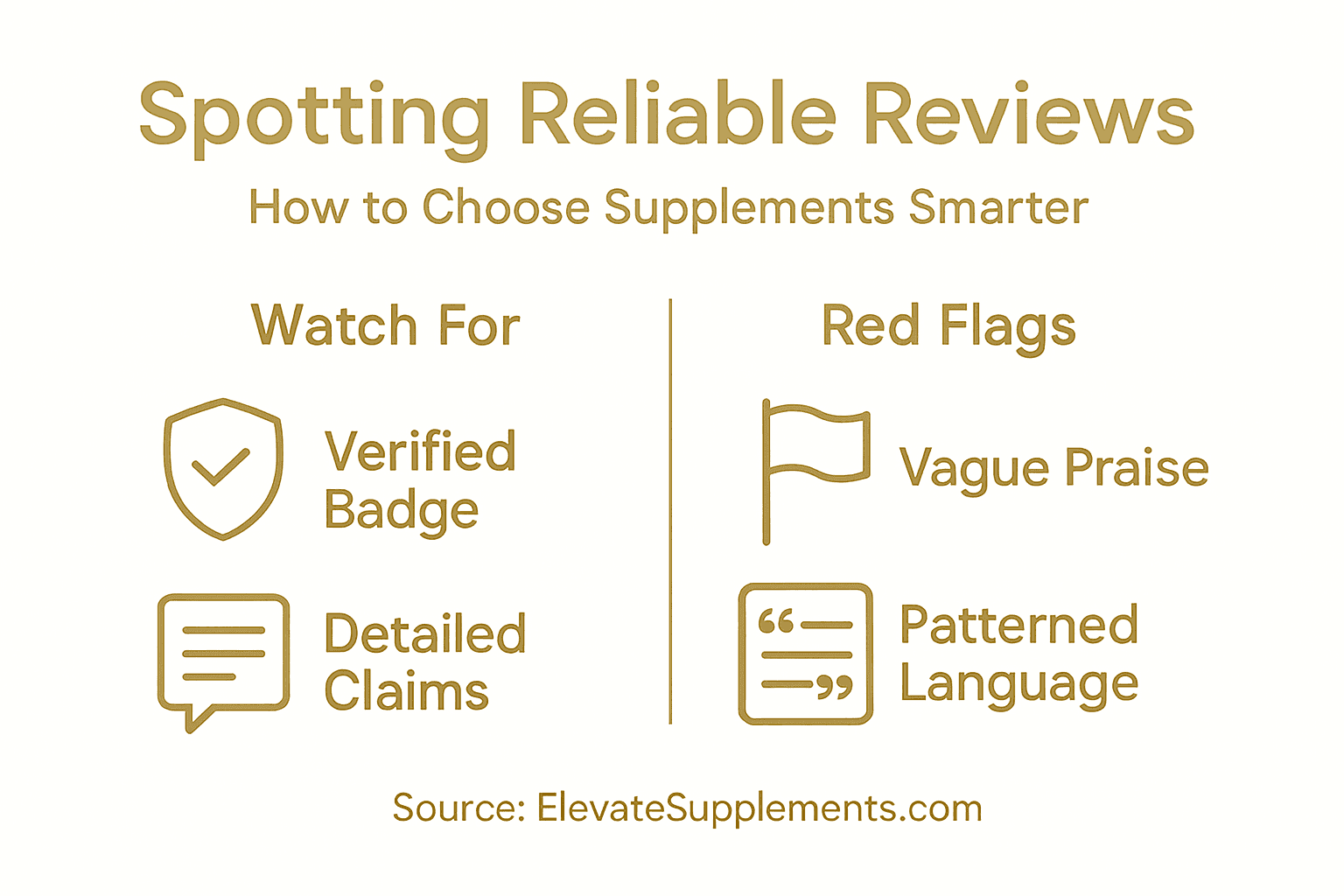
Look for review volume combined with variety. Mixed ratings (mostly four to five stars with some three stars) feel more authentic than unanimous perfection.
Pro tip: Read negative reviews first—they reveal actual problems competitors face, then cross-reference positive reviews to see whether those issues affect your specific training needs.
Spotting Reliable Versus Misleading Reviews
Fake reviews are everywhere. Supplement brands sometimes pay for positive feedback or use fake accounts to inflate ratings. You need practical skills to distinguish genuine user experiences from manufactured hype.
The good news: fake reviews follow predictable patterns. Once you know what to look for, spotting them becomes straightforward.
Red Flags for Fake Reviews
Misleading reviews often cluster on specific dates, use repetitive phrases, and come from accounts with minimal activity. If you notice a sudden flood of five-star reviews all posted within days of each other, that’s suspicious.
Watch for these warning signs:
- Identical language – Multiple reviews using the same words or phrasing
- Generic praise – “Amazing product!” with no specific details about what it does
- Perfect timing – All positive reviews arrive suddenly, then stop
- New accounts – Reviews from accounts with no purchase history elsewhere
- Vague benefits – Claims about results without mentioning actual improvements
Fake reviews rarely include specifics because they’re written by people who haven’t used the product.
Markers of Genuine Reviews
Reliable reviews show consistent characteristics across time. Trustworthy feedback comes from verified purchases, shows varied ratings, and appears scattered across different dates. Genuine reviewers don’t all agree perfectly.
Look for these authenticity signals:
- Verified purchase badges – Proof someone actually bought it
- Mixed ratings – Some four stars, some five stars, occasionally three
- Detailed narratives – Specific context (training type, body composition, goals)
- Honest trade-offs – Mentions both benefits and drawbacks
- Reviewer history – They’ve reviewed other products, showing legitimate account use
Real reviews come from real athletes. They’re specific, scattered over time, and often mention both what worked and what didn’t.
Genuine users write about their actual experience. They mention dosage timing, how long results took, and whether they’d buy again.
Verification Techniques
Don’t rely on star ratings alone. Read the review text carefully. Check whether the reviewer’s other reviews show consistent patterns or whether they suspiciously only review one brand.
Verified purchase badges matter significantly. Anonymous reviews without this badge deserve more scrutiny, though they’re not automatically fake.
Pro tip: Cross-reference supplement reviews across multiple websites—if a product has genuine quality, you’ll see consistent feedback patterns on independent sites and retailer pages, whereas fake review campaigns typically target single platforms.
Maximising Results: Using Reviews Responsibly
Reading reviews wisely is only half the equation. You also need to use that information strategically to make purchasing decisions that actually serve your training goals rather than just chasing marketing hype.
Responsible review usage means understanding your own biases and comparing multiple sources before committing money. It’s the difference between making informed choices and simply following the crowd.
Cross-Checking Multiple Sources
Never base your decision on a single review or platform. A supplement might have five stars on one retailer’s site but mixed feedback elsewhere. Check at least three independent sources before purchasing anything significant.
Different platforms attract different reviewers:
- Retailer websites – Direct purchasers, but brands may curate feedback
- Independent review sites – No financial stake, but smaller reviewer pools
- Fitness forums – Athletes discussing real results, but less formal evaluation
- Scientific databases – Research-backed information, but not personal experience
Combining all four sources gives you the complete picture.
This table summarises ways to cross-check supplement review authenticity across sources:
| Source Type | Key Advantage | Main Drawback |
|---|---|---|
| Retailer Sites | Large sample, verified buyers | Potential review curation |
| Independent Review Sites | Neutral perspective | Smaller reviewer pool |
| Fitness Forums | Real athlete experiences | Informal, less structured |
| Scientific Publications | Research-backed findings | Often lacks user context |
Understanding Reviewer Backgrounds
Cross-checking multiple sources and considering reviewer backgrounds helps you make informed choices. A five-star review from a professional bodybuilder might not apply to your strength-focused routine.
Always consider:
- Training experience level – Are they similar to you?
- Body composition goals – Do their objectives match yours?
- Dietary context – What else are they consuming?
- Timeline – How long did they use the supplement?
A reviewer’s context determines whether their results are predictive of yours.
Recognising Incentive Bias
Responsible businesses disclose material connections and avoid suppressing negative reviews. If a review mentions they received the product free or were paid, that’s a material connection you need to know.
These incentivised reviews aren’t automatically dishonest, but they do create bias. Someone paid to review a supplement is more likely to emphasise positives and downplay drawbacks.
The most valuable reviews often come from people who paid full price and took time to share both benefits and limitations.
When you see disclosure statements about compensation, adjust your trust accordingly—not to zero, but with appropriate scepticism.
Your Action Plan
Before purchasing any new supplement, spend 15 minutes on this process:
- Read 3–5 detailed reviews mentioning specific results
- Check for verified purchase badges and reviewer history
- Identify 2–3 reviewers similar to your training style
- Note what positive and negative feedback emerges repeatedly
- Cross-reference with scientific backing from independent sources
This systematic approach eliminates most poor purchasing decisions.
Pro tip: Save reviews from athletes in your specific sport or training discipline in a spreadsheet—over months, you’ll recognise which reviewers consistently predict your own results, making their future feedback invaluable for decisions.
Choose Wisely with Trusted Reviews and Premium Supplements
Making well-informed decisions about your supplements can be challenging. The article highlights the importance of credible reviews that evaluate scientific backing, user experience, and product quality for athletes and fitness enthusiasts. You deserve supplements that truly support your performance and recovery without risking safety or wasting money. At Elevate Supplements, we understand this struggle and provide you with a carefully selected range combining quality ingredients and verified customer feedback.
Explore our full collection of high-grade products curated to meet diverse fitness goals. Our selection includes protein powders, amino acids, and targeted formulations designed to maximise your training outcomes while emphasising transparency and trust. Experience fast UK and Ireland delivery, secure checkout, and customer-centred service throughout your purchasing journey.
Start elevating your supplement choices today by browsing ALL ELEVATE PRODUCTS – ElevateSupplements / Elevate Your Supplements. For a quicker shopping experience, visit our Quick Order – ElevateSupplements / Elevate Your Supplements page. Ready to make a confident and effective investment in your health and performance goals? Visit us now at Elevate Supplements and choose supplements backed by science and real-world results.
Frequently Asked Questions
What factors should I consider when reading supplement reviews?
Look for scientific backing, user results, product quality, safety profiles, and value for money. Quality reviews should address these aspects to help you make informed decisions.
How do single-ingredient and combination supplement reviews differ?
Single-ingredient reviews assess proven effects of individual nutrients, making efficacy easier to determine. In contrast, combination reviews focus on the interactions between multiple ingredients, which can complicate understanding their true effectiveness.
Why are user experience reviews important?
User experience reviews provide real-world feedback on how supplements perform during training. They complement clinical research by showcasing practical outcomes that matter to athletes and fitness enthusiasts.
How can I spot fake reviews?
Be cautious of reviews that use identical language, offer vague praise, or cluster around specific dates. Look for verified purchase badges, mixed ratings, and detailed narratives to identify genuine feedback.
Recommended
- METABOLIC BOOSTER 2.0 – ElevateSupplements / Elevate Your Supplements
- ORGAN SUPPORT (30 SERVINGS) – ElevateSupplements / Elevate Your Supplements
- Elevate Supplements | Elevate Your Supplements – ElevateSupplements / Elevate Your Supplements
- ALL ELEVATE PRODUCTS – ElevateSupplements / Elevate Your Supplements
- 7 Steps to the Ultimate Nutritional Supplement Checklist


