


TL;DR:
- Magnesium is essential for muscle function, energy production, and recovery, especially in athletes.
- Supplementation is beneficial mainly when deficient, as confirmed by testing, not for general performance enhancement.
- High-absorption forms like citrate and bisglycinate are recommended, with doses kept below 350 mg daily.
Magnesium is one of those minerals that gets thrown into every conversation about sports nutrition, yet most people either overlook it completely or assume that more is always better. Neither approach is right. Essential for over 300 enzyme processes, magnesium plays a central role in muscle function, energy production, and recovery. But the evidence tells a more nuanced story: supplementing without knowing your status can actually work against you. This article breaks down what magnesium does, who genuinely needs it, and how to use it effectively.
Table of Contents
- What magnesium does for your body
- Who needs magnesium supplementation?
- The evidence for magnesium: Performance, recovery and muscle cramps
- Choosing supplements: Bioavailability and safety
- Our perspective: When magnesium supplementation makes sense
- Discover high-quality supplements to support your goals
- Frequently asked questions
Key Takeaways
| Point | Details |
|---|---|
| Magnesium powers performance | It supports over 300 enzyme actions, impacting muscles, energy, and nerves directly relevant to fitness. |
| Not everyone needs supplements | Athletes benefit most when truly deficient, but testing status first is crucial before supplementing. |
| Supplement form matters | Citrate and bisglycinate offer superior absorption and fewer side effects for most users. |
| Dose and safety are key | Stick to under 350mg/day supplemental magnesium for minimal side effects and consult with your doctor. |
What magnesium does for your body
Magnesium is not just another micronutrient ticking away quietly in the background. It is an active player in the processes that make training, strength, and recovery possible. As a cofactor in over 300 enzyme reactions, including ATP synthesis and muscle contraction, it sits at the intersection of almost every energy-producing pathway in the body. Without adequate magnesium, those pathways slow down.
About 60% of your body’s magnesium is stored in bone, with most of the remainder held in muscle tissue. Only roughly 1% circulates in the blood, which is why blood tests alone are not always a reliable indicator of your true status. This storage distribution matters for athletes: during prolonged or intense exercise, the body draws on these reserves faster than they can be easily replenished through food alone.
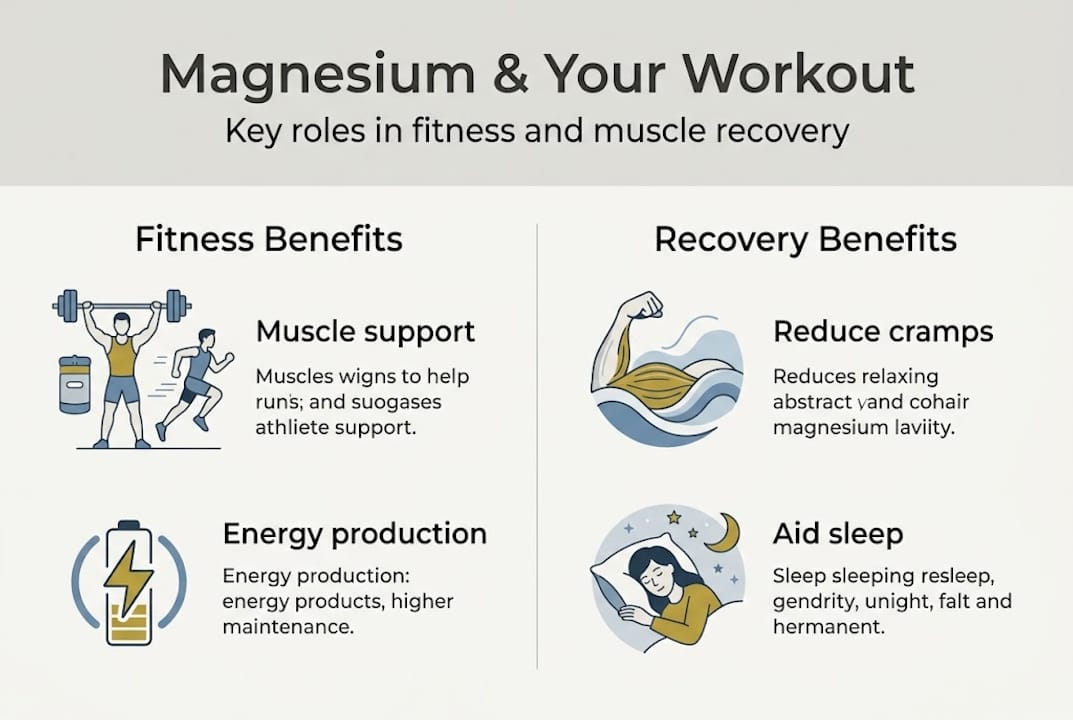
Here is a quick overview of magnesium’s key roles in a fitness context:
- Muscle contraction and relaxation: Magnesium regulates calcium movement into muscle cells, which governs contraction and relaxation cycles.
- Energy production: It is required for the activation of ATP, the body’s primary energy currency.
- Protein synthesis: Magnesium supports the creation of new muscle proteins following training.
- Nervous system function: It modulates nerve signal transmission, which affects reaction time and neuromuscular coordination.
- Sleep and stress response: Magnesium influences cortisol regulation and promotes deeper, more restorative sleep.
Daily requirements and dietary sources
| Group | Recommended daily amount (RDA) |
|---|---|
| Adult men (19 to 30) | 400 mg/day |
| Adult men (31+) | 420 mg/day |
| Adult women (19 to 30) | 310 mg/day |
| Adult women (31+) | 320 mg/day |
Rich dietary sources include dark leafy greens, nuts, seeds, legumes, wholegrains, and dark chocolate. The challenge is that modern food processing strips away a significant portion of the magnesium naturally present in whole foods, meaning many people fall short without realising it.
Who needs magnesium supplementation?
Not everyone training regularly needs to reach for a supplement. But certain groups are genuinely at higher risk of running low, and understanding whether you fall into one of those groups is the most important step.

Athletes experience increased magnesium loss through sweat and urine, particularly those with low dietary intake or high training volumes. This is compounded when athletes follow restrictive diets, avoid whole food groups, or compete in endurance, weight-class, or aesthetic sports where food intake is closely managed.
Groups most likely to need supplementation:
- Endurance athletes (runners, cyclists, triathletes) with high sweat rates
- Athletes following calorie-restricted or low-carbohydrate diets
- Individuals with high alcohol consumption, which impairs magnesium absorption
- Older adults, as magnesium absorption decreases with age
- People with gastrointestinal conditions such as Crohn’s disease or coeliac disease
- Those regularly consuming processed, low-nutrient diets
Signs that your magnesium may be low:
Early symptoms include persistent fatigue, muscle twitches, disrupted sleep, poor concentration, and more frequent cramps. Severe deficiency can lead to irregular heart rhythms and more serious neurological symptoms, though this is uncommon in otherwise healthy people.
“Low magnesium status is more common than most people think, particularly in those training hard while eating processed or calorie-restricted diets. Symptoms are easy to miss until they compound.”
Pro Tip: Before you start supplementing, ask your GP for a red blood cell magnesium test rather than a standard serum test. It gives a more accurate picture of your actual tissue magnesium levels.
The evidence for magnesium: Performance, recovery and muscle cramps
Here is where it gets interesting, and where the fitness industry sometimes oversells the case. The research on magnesium supplementation is genuinely mixed, and the outcome depends heavily on whether you are deficient to begin with.
What studies say:
- Recovery and soreness: Magnesium supplementation can reduce muscle soreness and support recovery in trained individuals, particularly when deficiency is present.
- Performance in deficient individuals: Correcting a deficiency reliably improves energy production, endurance, and strength output.
- Performance in non-deficient individuals: Short-term magnesium supplementation may actually lower VO2max or sprint performance in those who already have adequate levels.
- Muscle cramps: Magnesium is not proven effective for ordinary exercise-related cramps, though it may offer some benefit in specific groups such as pregnant women or those with confirmed deficiency.
The take-home here is clear: if your magnesium status is already sufficient, adding more is unlikely to give you an edge and could, in some cases, work against you. The performance benefits are strongest when they correct an existing shortfall, not when used as a general booster.
If you are exploring the best supplements for recovery, magnesium belongs in that conversation, but only as part of a targeted, evidence-based approach.
| Scenario | Potential benefit | Potential risk |
|---|---|---|
| Supplementing with confirmed deficiency | Improved recovery, energy, sleep | Very low if dose is appropriate |
| Supplementing without deficiency | Minimal to none | Possible performance reduction, GI upset |
| Correcting via food sources | Reliable, safe, additional nutrients | Requires dietary change |
Pro Tip: If you’re serious about recovery supplements for athletes, treat magnesium as a foundation mineral, not a performance shortcut. It works best when it fills a genuine gap.
Choosing supplements: Bioavailability and safety
If you have confirmed that supplementation is the right move, the next question is which form to choose. Not all magnesium supplements are equal, and the difference in absorption between forms is significant.
Citrate, aspartate, lactate, and chloride are better absorbed than oxide or sulphate. Magnesium oxide is one of the most common and cheapest forms on the market, but it has poor bioavailability and is more likely to cause digestive discomfort. Magnesium bisglycinate (magnesium bound to the amino acid glycine) is another well-absorbed option with a gentler effect on the gut, making it a popular choice for regular use.
Comparison of common magnesium supplement forms:
| Form | Absorption | GI side effects | Best for |
|---|---|---|---|
| Magnesium citrate | High | Mild (can loosen stools) | General use, constipation |
| Magnesium bisglycinate | High | Very low | Daily supplementation, sleep |
| Magnesium oxide | Low | Common | Not recommended for performance |
| Magnesium chloride | High | Low to moderate | Topical or oral use |
| Magnesium sulphate | Moderate | High | Short-term or medical use |
Key safety guidance:
- Stay below 350 mg/day from supplements alone (food-based magnesium does not carry the same risk)
- Split doses across the day to improve absorption and reduce GI side effects
- Avoid very high doses, which can cause diarrhoea, nausea, and in extreme cases, cardiovascular issues
- Supplements are only necessary when dietary sources are genuinely insufficient
Pro Tip: Before buying a supplement, look at the elemental magnesium content on the label, not just the total compound weight. A 500 mg tablet of magnesium oxide may only contain around 300 mg of actual magnesium. To maximise supplement absorption, take magnesium with food and avoid combining it with high-dose zinc or calcium in the same sitting. Always review magnesium safety tips if you are taking other medications.
If you want a reliable, well-absorbed option, magnesium bisglycinate is one of the more sensible choices for regular supplementation.
Our perspective: When magnesium supplementation makes sense
Here is the honest take: the fitness supplement market has a habit of turning conditional evidence into universal recommendations, and magnesium is a prime example. The research is solid, but it consistently points to one conclusion: this mineral is most beneficial when it addresses a genuine deficiency, not when it is added on top of an already sufficient intake.
Experts favour food sources over supplements and caution against supplementing purely for performance gains without first assessing status. We agree. At Elevate Supplements, we see the value in magnesium for the right person: the endurance athlete sweating through heavy training blocks, the dieter cutting calories and whole food groups, the individual whose sleep and recovery quality has noticeably declined.
For those people, targeted supplementation can make a real difference. But the starting point should always be testing your levels, not guessing. The goal is to restore what’s genuinely missing, and to do that with a well-absorbed form at a sensible dose. If your dietary intake from sources like the supplements for muscle recovery context alongside quality food is solid, you may not need a tablet at all.
Discover high-quality supplements to support your goals
If your training, recovery, or sleep quality is telling you something is off, it may be worth exploring whether magnesium is part of the picture. At Elevate Supplements, we stock a carefully selected range of science-backed products designed for fitness enthusiasts and athletes who want results without the guesswork.

Our magnesium bisglycinate is formulated for high absorption and gentle tolerability, making it one of the smarter choices for daily support. Whether you are looking to optimise recovery, improve sleep, or address a genuine dietary gap, shop Elevate Supplements to find the right product for your goals. Fast UK and Ireland delivery, free shipping on orders over £100, and a team ready to help you make the right call.
Frequently asked questions
How do I know if I need magnesium supplements?
The best approach is to speak with a GP and request a red blood cell magnesium test, particularly if you train intensely or notice symptoms like fatigue and muscle cramps. Deficiency is more common with high activity levels and low dietary intake.
Does magnesium help with muscle cramps during exercise?
For most people, there is limited evidence that magnesium prevents exercise-related cramps. However, magnesium is not proven effective for ordinary cramps, though it may offer benefit when a deficiency is confirmed.
Are there side effects of taking magnesium supplements?
Generally, supplements under 350 mg/day are well tolerated in healthy adults. GI side effects are more common above this dose, including diarrhoea, bloating, and nausea.
Which form of magnesium is best absorbed?
Citrate, lactate, and chloride forms are typically absorbed more effectively than oxide or sulphate. Citrate and bisglycinate are generally considered among the best options for daily supplementation due to their high bioavailability and low GI impact.
Recommended
- 6 Best Supplements for Muscle Recovery: Athlete’s Guide – ElevateSupplements
- Sports supplementation: boost performance, recovery and wellness – ElevateSupplements
- Why recovery supplements matter for athletes in 2026 – ElevateSupplements
- Why use amino acids for better muscle health in 2026 – ElevateSupplements
- Magnesium Glycinate – Sleep & Muscle Support | LUMIEVE – LUMIEVE


