


You’re buying quality supplements, stacking them carefully, and training hard. Yet the results feel underwhelming. The frustrating truth is that what you take matters far less than when you take it. Timing your supplements correctly can be the difference between a plateau and genuine progress. This guide walks you through the science, the practical day-by-day framework, and the common mistakes that quietly sabotage even the best supplement routines, so you can finally get the most from every dose.
Table of Contents
- Why supplement timing matters for results
- What you need before you start: key supplements and best practices
- Step-by-step supplement timing: a day in the life
- Troubleshooting: common mistakes and how to avoid them
- What to expect: results, verification, and adjusting your protocol
- Where to find high-quality supplements for your routine
- Frequently asked questions
Key Takeaways
| Point | Details |
|---|---|
| Timing boosts effect | Strategic supplement timing can significantly enhance training results and recovery. |
| Pair with food or activity | Match supplements to meals or workouts for optimal absorption and effect. |
| Avoid nutrient clashes | Space out certain minerals to prevent absorption issues and maximise benefits. |
| Consistency matters | Sticking to your timing routine is often more important than the exact minute you take each dose. |
| Food comes first | Supplements work best as additions to a balanced diet, not as substitutes. |
Why supplement timing matters for results
Your body is not a static machine. It processes nutrients differently depending on your activity level, hormonal state, and what you’ve eaten. A protein shake taken at the right moment can accelerate muscle repair; the same shake taken at the wrong time may offer little more than extra calories.
“The timing of nutrient intake is not a minor detail. It is a fundamental variable in how effectively your body uses what you give it.”
The post-exercise window is one of the most well-researched concepts in sports nutrition. Consuming protein and carbohydrates immediately after training boosts muscle protein synthesis and glycogen recovery compared to delayed intake. Miss that window and you leave real gains on the table.
That said, supplements are not magic. The British Heart Foundation is clear that supplements are often unnecessary if your diet is already balanced, and food should always come first. Think of supplements as precision tools that fill specific gaps, not replacements for a solid nutritional base.
Here is where timing becomes genuinely powerful:
- Pre-workout: Stimulants, nitric oxide boosters, and BCAAs prime your body for performance
- Intra-workout: Electrolytes and EAAs sustain energy and prevent muscle breakdown during long sessions
- Post-workout: Protein and creatine accelerate repair and adaptation
- Evening: Casein, magnesium, and ZMA support overnight recovery and sleep quality
Understanding these windows is the first step to learning how to boost sport performance through smarter, more deliberate supplementation.
What you need before you start: key supplements and best practices
Before you build a timing plan, you need to know which supplements are actually worth your attention. Not every product on the shelf earns a place in a serious athlete’s routine. Here are the core players:
- Whey protein: Fast-digesting, ideal post-workout
- Casein protein: Slow-release, best before bed
- BCAAs and EAAs: Muscle protection, especially during fasted training
- Creatine monohydrate: Strength and power output, taken consistently
- Vitamin D and other fat-soluble vitamins: Immune and hormonal support
- Magnesium: Muscle function and sleep quality
- ZMA (zinc, magnesium, B6): Recovery and testosterone support overnight
| Supplement | Purpose | Optimal timing | Key benefit | Meal consideration |
|---|---|---|---|---|
| Whey protein | Muscle repair | Post-workout | Fast absorption | Can be taken without food |
| Casein | Overnight recovery | Before bed | Slow release | Light snack or alone |
| Creatine | Strength and power | Post-workout | Consistent saturation | With protein and carbs |
| BCAAs/EAAs | Muscle protection | Pre/intra/post | Prevents catabolism | Useful fasted |
| Vitamin D | Immune and hormonal | Morning | Fat-soluble absorption | With a fatty meal |
| Magnesium | Sleep and muscle | Evening | Relaxation and recovery | With food to avoid nausea |
| ZMA | Recovery and hormones | Before bed | Sleep quality | On an empty stomach |
Creatine monohydrate works best post-workout when paired with protein and carbohydrates, though consistency across days matters more than hitting a perfect window every single time.

Pro Tip: Always read your supplement labels for serving size and any noted interactions. Some products already combine ingredients, so doubling up can push you past effective doses without adding benefit.
Making sure supplement quality matters is non-negotiable. Third-party tested products with transparent ingredient lists give you confidence that what is on the label is actually in the tub.
Step-by-step supplement timing: a day in the life
Here is a practical timeline you can adapt to your own training schedule:
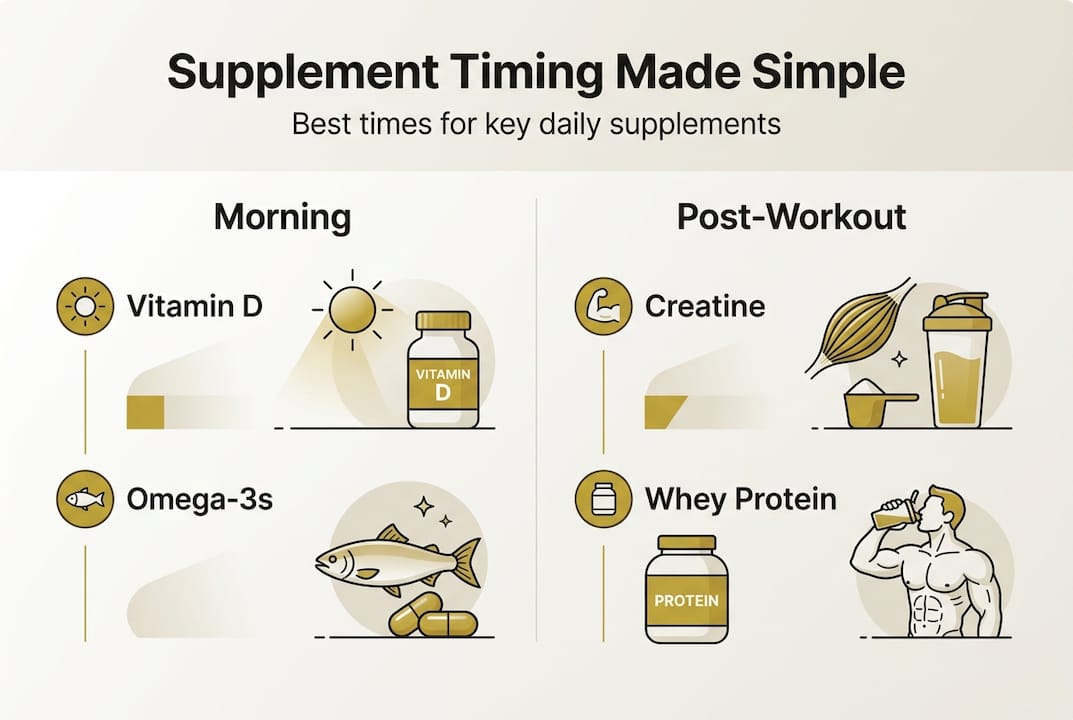
- On waking (6:00 to 7:00am): Take vitamin D with a small meal containing healthy fats. Fat-soluble vitamins like vitamin D are absorbed best in the morning alongside fat-containing food.
- Breakfast (7:00 to 8:00am): Omega-3s pair well here. Check out how omega-3s for recovery can reduce inflammation and support joint health over time.
- 30 minutes pre-workout: Pre-workout formula or caffeine if used. BCAAs or EAAs are especially valuable here if you are training in a fasted state.
- During training (intra-workout): Sip on EAAs or electrolytes during sessions longer than 60 minutes. BCAAs and EAAs have maximum effect when taken pre, intra, or post-workout during fasted or endurance training.
- Immediately post-workout (within 30 to 45 minutes): Whey protein with fast-digesting carbs. Add creatine here for best uptake.
- Evening meal: Magnesium with food to avoid digestive discomfort.
- Before bed: Casein protein and ZMA on an empty stomach to support overnight muscle repair and sleep quality.
| Time of day | Supplement | Reason |
|---|---|---|
| Morning | Vitamin D, omega-3s | Absorption with fats |
| Pre-workout | BCAAs/EAAs, caffeine | Performance and protection |
| Intra-workout | EAAs, electrolytes | Endurance and hydration |
| Post-workout | Whey, creatine | Repair and adaptation |
| Evening | Magnesium | Muscle relaxation |
| Before bed | Casein, ZMA | Overnight recovery |
Pro Tip: If you train early in the morning in a fasted state, prioritise EAAs before and during your session. This protects muscle tissue without the digestive load of a full protein shake.
For a deeper look at what supports your body between sessions, the recovery supplements guide covers the full picture of post-training nutrition.
Troubleshooting: common mistakes and how to avoid them
Even athletes with solid routines make timing errors that quietly chip away at their results. Here are the most common ones:
- Taking all supplements at once: Batch-dosing everything in the morning is convenient but ineffective. Your body can only absorb and utilise so much at one time.
- Ignoring food pairings: Fat-soluble vitamins taken without fat are largely wasted. Iron taken with calcium is poorly absorbed.
- Skipping timing on rest days: Creatine and protein still matter on non-training days. Muscle repair and adaptation continue long after you leave the gym.
- Neglecting mineral spacing: Calcium blocks absorption of iron and zinc, so space your minerals throughout the day rather than taking them together.
“Nutrient competition is one of the most overlooked issues in supplement routines. Spacing minerals by at least two hours can meaningfully improve what your body actually absorbs.”
Practical fixes are straightforward. Set phone reminders for each supplement window. Build your timing plan into your meal prep routine so it becomes automatic. And test your individual response: some people feel a clear difference from pre-workout BCAAs, others do not. Adjust based on what you actually notice.
For a broader look at staying safe and effective with your stack, the supplement safety tips resource is worth bookmarking.
What to expect: results, verification, and adjusting your protocol
Once you implement a structured timing plan, the signs of progress are usually noticeable within two to four weeks. Here is what to look for:
- Improved energy during training: Pre-workout and intra-workout supplements are working
- Faster recovery between sessions: Less soreness, more readiness to train again
- Better sleep quality: Evening magnesium and ZMA are doing their job
- Gradual strength increases: Creatine saturation building over consistent use
- Reduced muscle soreness: Post-workout protein and EAAs accelerating repair
Keep a simple log. Note your supplement timing, training performance, and how you feel each morning. Patterns emerge quickly and give you the data to fine-tune your approach.
Remember, food comes first for UK athletes. Supplements fill gaps; they do not replace a diet built around whole foods, lean proteins, and quality carbohydrates. If your results plateau, revisit your nutrition before adding more products.
For targeted support between sessions, the guide on how to cut recovery time offers practical strategies that complement everything covered here.
Where to find high-quality supplements for your routine
Putting a timing plan into practice is only as effective as the products you use. At Elevate Supplements, every product in our range is selected for quality, transparency, and performance. Whether you are building your first stack or refining an existing routine, we have what you need.
Start with the essentials: [Elevate Whey Protein](https://elevatesupplementsstore.com/products/elevate whey protein) for post-workout recovery, pure Creatine Monohydrate for consistent strength gains, and Essential Amino Acids to protect muscle during every session. We offer fast delivery across the UK and Ireland, free shipping on orders over £100, and a 24/7 support team ready to help you build the right stack for your goals. Browse the full catalogue and start timing your supplements with confidence.
Frequently asked questions
What is the best time to take creatine?
Creatine absorption is slightly enhanced post-workout when paired with protein and carbohydrates, but taking it consistently every day matters more than hitting a perfect window.
Should I take BCAAs before, during, or after a workout?
Take BCAAs or EAAs 15 to 30 minutes before training, or during and after if you are training fasted. BCAAs and EAAs are most effective pre, intra, and post-workout, particularly during fasted or endurance sessions.
How should I take fat-soluble vitamins for best results?
Take vitamins A, D, E, and K with a meal that contains fat to maximise absorption. Vitamin D is best taken in the morning alongside a fat-containing meal for optimal uptake.
Can I take all my supplements at the same time?
Avoiding this is strongly advised. Calcium blocks absorption of iron and zinc, so space your minerals throughout the day to ensure each one is properly absorbed.
Is it important to use supplements if my diet is already balanced?
Most people do not need supplements with a well-balanced diet. The British Heart Foundation advises focusing on food first and only supplementing where a genuine dietary gap exists.
Recommended
- How to plan supplement cycles for peak performance 2026 – ElevateSupplements
- How to Choose Supplements for Peak Performance Results – ElevateSupplements
- Maximize Supplement Absorption: Boost Uptake by 100% – ElevateSupplements
- Top supplement stacking tips for optimal performance – ElevateSupplements
- Дневни ритуали за продуктивност с натурални добавки – Neurofuel™️


